what allows membranes to be permeable to small ions?
thirteen Membranes
Membrane Lipids
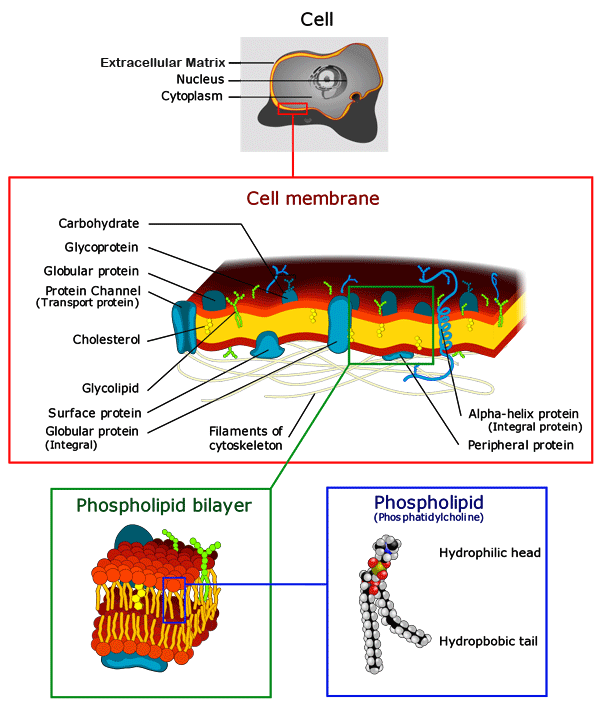
The cell membrane is a dynamic structure equanimous of lipids, proteins, and carbohydrates. It protects the cell by preventing materials from leaking out, controls what can enter or leave through the membrane, provides a binding site for hormones and other chemicals, and serves as an identification carte for the immune system to distinguish between "self" and "not-cocky" cells. We will commencement investigate the anatomy of the prison cell membrane and then continue on to study the physiology of membrane send.
The phospholipid bilayer is the main material of the membrane. The bilayer'due south construction causes the membrane to exist semi-permeable. Remember that phospholipid molecules are amphiphilic (amphipathic), which means that they contain both a nonpolar and polar region. Phospholipids have a polar head (it contains a charged phosphate group) with two nonpolar hydrophobic fatty acrid tails. The tails of different phospholipids face each other in the core of the membrane while the polar heads face either the exterior of interior of the cell. Having the polar heads oriented toward the external and internal sides of the membrane allows them to interact with the polar h2o molecules found on each side of the membrane. The hydrophobic cadre blocks the diffusion of hydrophilic ions and polar molecules. Small hydrophobic molecules and gases, which can dissolve in the membrane'southward core, cross it with ease.
Other molecules require proteins to transport them across the membrane. Proteins decide near of the membrane's specific functions. The plasma membrane and the membranes of the diverse organelles each have unique collections of proteins. For example, to date more than 50 kinds of proteins have been found in the plasma membrane of red claret cells [1].
Importance of Phospholipid Membrane Structure
What is of import about the structure of a phospholipid membrane? First, it is fluid. This allows cells to modify shape, permitting growth and motion. The fluidity of the membrane is regulated by the types of phospholipids and the presence of cholesterol. Second, the phospholipid membrane is selectively permeable.
The ability of a molecule to pass through the membrane depends on its polarity and to some extent its size. Many non-polar molecules such as oxygen, carbon dioxide, and pocket-size hydrocarbons can flow hands through cell membranes. This feature of membranes is very important because hemoglobin, the poly peptide that carries oxygen in our blood, is contained within cherry blood cells. Oxygen must be able to freely cross the membrane and then that hemoglobin can get fully loaded with oxygen in our lungs, and deliver it effectively to our tissues.
Most polar substances are stopped by a jail cell membrane, except perhaps for minor polar compounds like the one carbon booze, methanol. Glucose is too big to pass through the membrane unassisted and a special transporter protein ferries it beyond. One type of diabetes is caused by misregulation of the glucose transporter. This decreases the ability of glucose to enter the cell and results in high claret glucose levels.
Charged ions, such every bit sodium (Na+) or potassium (K+) ions seldom become through a membrane, consequently they also demand special transporter molecules to pass through the membrane. The inability of Na+ and K+ to pass through the membrane allows the cell to regulate the concentrations of these ions on the inside or outside of the cell. The conduction of electrical signals in your neurons is based on the power of cells to control Na+ and K+ levels.
Selectively permeable membranes allow cells to go on the chemistry of the cytoplasm dissimilar from that of the external environs. It besides allows them to maintain chemically unique conditions inside their organelles.
Fluidity of Prison cell Membranes
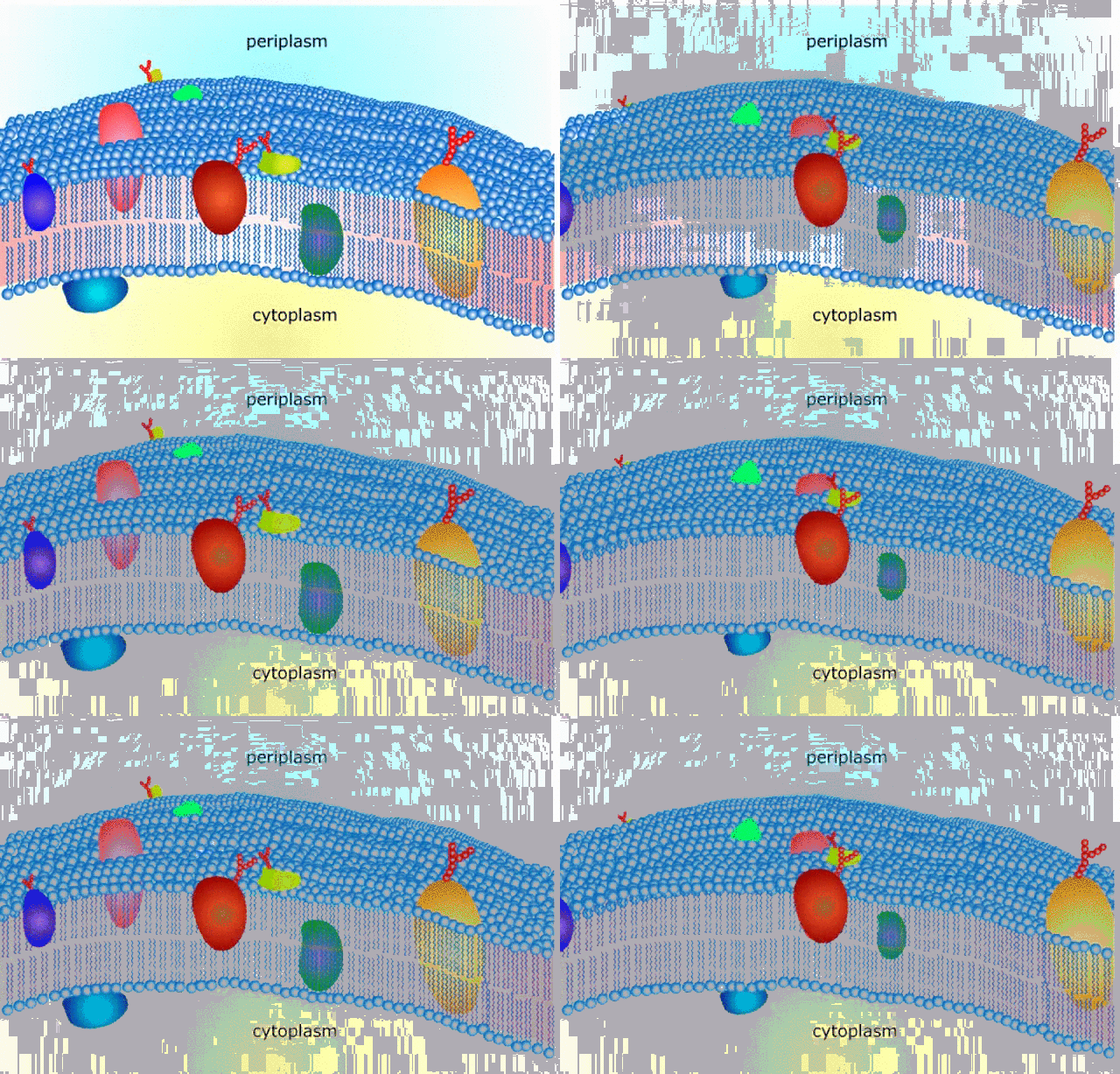
The cell membrane is not a static structure. It is a dynamic structure that allows for the lateral motility of phospholipids and proteins. Fluidity is a term used to depict the ease of movement of molecules in the membrane and is an of import characteristic for cell office. Fluidity is dependent on the temperature (increased temperatures increase fluidity and decreased temperatures decrease fluidity), and the concentrations of saturated fat acids and unsaturated fatty acids. Saturated fatty acids brand the membrane less fluid while unsaturated fatty acids make it more fluid. The correct ratio of saturated to unsaturated fatty acids keeps the membrane fluid at any temperature conducive to life. In animal cells, cholesterol helps to forbid the packing of fatty acid tails and thus lowers the requirement of unsaturated fatty acids. This helps maintain the fluid nature of the cell membrane without information technology becoming too liquid at body temperature.
The lipid bilayer is the master fabric of the membrane, and its structure creates a semipermeable membrane. The hydrophobic core impedes the diffusion of hydrophilic structures such as ions and polar molecules, but allows hydrophobic molecules, which can dissolve in the membrane, to cantankerous it with ease. The lipids in the membrane are in random bulk flow moving about 22 µm (micrometers) per second. Phospholipids freely motility in the same layer of the membrane and rarely flip to the other layer. Flipping of phospholipids from 1 layer to the other rarely occurs because flipping requires the hydrophilic head to laissez passer through the hydrophobic region of the bilayer.
Membrane Proteins
Membranes as well contain proteins, which carry out many of the functions of the membrane. Some functions of membrane proteins are:
- Ship . Because the plasma membrane provide a barrier to the movement of many molecules, the cell needs a way to ship larger materials and hydrophilic molecules into and out of the cell.
- Communication . Because the plasma membrane is the border of the cell, this is where the prison cell communicates with its environment. Membrane proteins are able to receive signals from exterior the jail cell and begin a chain of events that crusade the prison cell to reply to these signals.
- Metabolism . Membrane proteins tin be enzymes that are involved in the chemic reactions of metabolism. These are the processes that allow the cell to abound, obtain free energy, and eliminate wastes.
- Adhesion . Membrane proteins help cells bind to each other so that they can form tissues. I instance of this is skin cells, which must form a tight, waterproof connectedness betwixt the cells in order to maintain proper integrity of the skin as an organ. Membrane proteins also bind to structural molecules inside and outside the cell then that cellular structure can be maintained.
Membrane proteins are classified into two major categories: integral proteins and peripheral proteins. Integral membrane proteins are those proteins that are embedded in the lipid bilayer and are by and large characterized by their solubility in nonpolar, hydrophobic solvents. Transmembrane proteins are examples of integral proteins with hydrophobic regions that completely span the hydrophobic interior of the membrane. The parts of the protein exposed to the interior and exterior of the cell are hydrophilic. Integral proteins can serve as pores that selectively allow ions, nutrients, and wastes into or out of the jail cell. They can also transmit signals across the membrane.
Unlike integral proteins that bridge the membrane, peripheral proteins reside on just one side of the membrane and are often fastened to integral proteins. Some peripheral proteins serve equally ballast points for the cytoskeleton or extracellular fibers. Proteins are much larger than lipids and movement more slowly than phospholipids in the membrane. Some motility in a seemingly directed manner, while others migrate. Some are glycoproteins which have a carbohydrate grouping attached to the protein. These are on the outside of the membrane and important for cell recognition, they piece of work like a cellular identification card.
Source: https://pressbooks.ccconline.org/bio106/chapter/membranes/
0 Response to "what allows membranes to be permeable to small ions?"
Post a Comment