Information on the Symptoms of a Beef Tapeworm Infection
| Taeniasis | |
|---|---|
 | |
| The life wheel of Taenia saginata, the beefiness tapeworm | |
| Specialty | Communicable diseases |
| Symptoms | None, weight loss, abdominal pain[1] |
| Complications | Pork tapeworm: cysticercosis[i] |
| Types | Taenia solium (pork tapeworm), Taenia saginata (beefiness tapeworm), Taenia asiatica (Asian tapeworm)[2] |
| Causes | Infection with adult tapeworms[two] [three] |
| Risk factors | Eating contaminated undercooked pork or beef[one] |
| Diagnostic method | Test of stool samples[4] |
| Prevention | Properly cooking meat[1] |
| Handling | Praziquantel, niclosamide[1] |
| Frequency | 50 one thousand thousand (with cysticercosis)[five] |
Taeniasis is an infection within the intestines by adult tapeworms belonging to the genus Taenia.[2] [3] There are by and large no or only mild symptoms.[2] Symptoms may occasionally include weight loss or abdominal pain.[i] Segments of tapeworm may be seen in the stool.[1] Complications of pork tapeworm may include cysticercosis.[1]
Types of Taenia that cause infections in humans include Taenia solium (pork tapeworm), Taenia saginata (beef tapeworm), and Taenia asiatica (Asian tapeworm).[two] Taenia saginata is due to eating contaminated undercooked beefiness while Taenia solium and Taenia asiatica is from contaminated undercooked pork.[two] Diagnosis is by exam of stool samples.[four]
Prevention is past properly cooking meat.[1] Handling is by and large with praziquantel, though niclosamide may besides be used.[i] Together with cysticercosis, infections affect about 50 meg people globally.[5] The illness is nearly common in the developing world.[1] In the United States less than i,000 cases occur a year.[1]
Signs and symptoms [edit]
Taeniasis by and large has few or no symptoms.[6] It takes about eight weeks from infection for adult worms to form and can last for years without treatment.[six]
Infection may be suspected when a portion of the worm is passed in the stool.[4] It is not mostly fatal.[7] [eight] [9]
Pork tapeworm [edit]
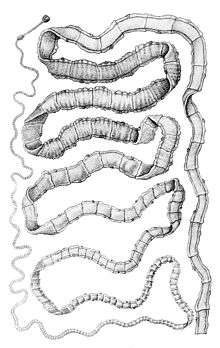
Infection in the intestines by the developed T. solium worms is normally asymptomatic. Heavy infection can result in anaemia and indigestion.[ commendation needed ]
A complexity, known as cysticercosis, may occur if the eggs of the pork tapeworm are eaten. This typically occurs from vegetables or water contaminated by carrion from someone with pork tapeworm taeniasis. The eggs enter the intestine where they develop into larvae which then enter the bloodstream and invade host tissues. This is the most frequent and severe disease acquired by any tapeworm. Information technology can lead to headaches, dizziness, seizures, dementia, hypertension, lesions in the brain, blindness, tumor-like growths, and low eosinophil levels. It is a cause of major neurological problems, such as hydrocephalus, paraplegy, meningitis, and expiry.[10]
Beef tapeworm [edit]
Taenia saginata infection is usually asymptomatic, but heavy infection causes weight loss, dizziness, abdominal hurting, diarrhea, headaches, nausea, constipation, chronic indigestion, and loss of appetite. It tin cause antigen reaction that induce allergic reaction.[11] It is likewise a rare crusade of ileus, pancreatitis, cholecystitis, and cholangitis.[12]
Asian tapeworm [edit]
Taenia asiatica is too ordinarily asymptomatic. It is unclear if T. asiatica tin crusade cysticercosis.[ane]
In pigs, the cysticercus can produce cysticercosis. Cysts develop in liver and lungs. (T. saginata does not cause cysticercosis.)[xiii]
Transmission [edit]
Taeniasis is contracted after eating undercooked pork or beef that contain the larvae. The adult worms develop and live in the lumen of the intestine. They acquire nutrients from the intestine. The gravid proglottids, body segments containing fertilised eggs, are released in the faeces.[ citation needed ]
If consumed by an intermediate host such equally a cow or pig, they hatch inside the duodenum to go larvae, penetrate through the intestinal wall into nearby blood vessels, and enter the bloodstream. Once they achieve organs such as the skeletal muscles, liver or lungs, the larvae then develop into a cyst, a fluid-filled cysticercus. These contaminated tissues are then consumed through raw or undercooked meat.[7]
Cysticercosis occurs when contaminated food, water, or soil that comprise T. solium eggs is eaten.[14] [fifteen]
Diagnosis [edit]

Diagnosis of taeniasis is mainly using stool sample, particularly by identifying the eggs. All the same, this has limitation at the species level because tapeworms basically have like eggs. Examination of the scolex or the gravid proglottids can resolve the exact species.[16] But body segments are not often available, therefore, laborious histological observation of the uterine branches and PCR detection of ribosomal 5.8S gene are sometimes necessary.[17] [18] Ziehl–Neelsen stain is also used for T. saginata and T. solium, in almost cases only the former will stain, but the method is non entirely reliable.[19] Loop-mediated isothermal amplification (LAMP) is highly sensitive (~2.5 times that of multiplex PCR), without fake positives, for differentiating the taenid species from faecal samples.[20]
To engagement the most relevant test for T. asiatica is by enzyme-linked immunoelectrotransfer blot (EITB). EITB can effectively place asiatica from other taenid infections since the serological test indicates an immunoblot ring of 21.5 kDa exhibited specifically by T. asiatica.[21] Even though it gives 100% sensitivity, it has not been tested with human sera for cross-reactivity, and it may show a high false positive result.[ citation needed ]
Prevention [edit]
Prevention efforts include properly cooking meat, treating active cases in humans, vaccinating and treating pigs confronting the disease, stricter meat-inspection standards, health teaching, improved sanitation, and improved pig raising practices.[1] [6]
Preventing human faeces from contaminating pig feeds also plays a part. Infection can be prevented with proper disposal of human faeces around pigs, cooking meat thoroughly and/or freezing the meat at −10 °C for five days. For human being cysticercosis, contaminated hands are the primary cause, and peculiarly concerning among food handlers.[7]
Proper cooking of meat is an effective prevention. For example, cooking (56 °C for 5 minutes) of beef viscera destroys cysticerci. Refrigeration, freezing (−ten °C for 9 days) or long periods of salting is as well lethal to cysticerci.[eleven]
Treatment [edit]
Praziquantel is the handling of option.[22] Usual treatments are with praziquantel (5–ten mg/kg, single-administration) or niclosamide (adults and children over 6 years: ii chiliad, single-administration after a light breakfast, followed after 2 hours past a laxative; children aged 2–vi years: 1 g; children under 2 years: 500 mg).[xi] I study showed albendazole is effective against fauna beef tapeworm cysticercosis.[23] Mepacrine is quite effective merely has agin effects in humans.[24]
Epidemiology [edit]
The total global infection is estimated to be betwixt 40 and threescore one thousand thousand people.[25] In the US, the incidence of infection is low, but 25% of cattle sold are still infected.[xvi]
Regions [edit]
Taeniasis is predominantly found in Asia, Africa, Latin America, particularly on farms in which pigs are exposed to human excrement. At a depression level though, information technology occurs everywhere where beef and pork are eaten, even in countries with strict sanitation policies such every bit the United States. Taenia saginata is relatively mutual in Africa, some parts of Eastern Europe,[26] the Philippines, and Latin America.[27] It is most prevalent in Sub-Saharan Africa and the Middle East.[28] Taenia asiatica is restricted to East Asia, including Taiwan, Korea, Indonesia, Nepal, Thailand and Communist china.[29] [30]
See also [edit]
- Tapeworm infection
References [edit]
- ^ a b c d e f g h i j thousand l k northward "CDC - Taeniasis - Full general Information - Oft Asked Questions (FAQs)". www.cdc.gov. 24 April 2019. Retrieved 16 Dec 2019.
- ^ a b c d e f "CDC - Taeniasis". www.cdc.gov. 24 April 2019. Retrieved 16 December 2019.
- ^ a b "CDC - Taeniasis - Biology". www.cdc.gov. 24 April 2019. Retrieved sixteen December 2019.
- ^ a b c "CDC - Taeniasis - Diagnosis". world wide web.cdc.gov. 24 April 2019. Retrieved 17 Dec 2019.
- ^ a b Griffiths, Jeffrey; Maguire, James H.; Heggenhougen, Kristian; Quah, Stella R. (2010). Public Health and Infectious Diseases. Elsevier. p. 216. ISBN978-0-12-381507-1.
- ^ a b c "Taeniasis/Cysticercosis". www.who.int . Retrieved 17 Dec 2019.
- ^ a b c Garcia, Oscar H. Del Brutto, Hector H. (2014). "Taenia solium: Biological Characteristics and Life Cycle". Cysticercosis of the Human Nervous System (one., 2014 ed.). Berlin: Springer-Verlag Berlin and Heidelberg GmbH & Co. KG. pp. xi–21. ISBN978-iii-642-39021-0.
- ^ "Nigh Taeniasis/cysticercosis". Archived from the original on March 14, 2014. Retrieved thirteen March 2014.
- ^ "Signs, symptoms and treatment of taeniasis/cysticercosis". Archived from the original on March 14, 2014. Retrieved 13 March 2014.
- ^ Flisser, A.; Avila K; Maravilla P; Mendlovic F; León-Cabrera S; Cruz-Rivera M; Garza A; Gómez B; Aguilar L; Terán N; Velasco S; Benítez Chiliad; Jimenez-Gonzalez DE (2010). "Taenia solium: electric current understanding of laboratory animal models of taeniosis". Parasitology. 137 (3): 347–57. doi:10.1017/S0031182010000272. PMID 20188011. S2CID 25698465.
- ^ a b c "Taeniasis/Cysticercosis". WHO Fact sheet N°376. World Health Organization. 2013. Retrieved seven February 2014.
- ^ Uygur-Bayramiçli, O; Ak, O; Dabak, R; Demirhan, G; Ozer, S (2012). "Taenia saginata a rare cause of acute cholangitis: a case report". Acta Clinica Belgica. 67 (vi): 436–7. doi:10.1179/ACB.67.six.2062709. PMID 23340150.
- ^ Galán-Puchades, K.T.; Fuentes, Thousand.V. (2008). "Taenia asiatica and pig cysticercosis". Veterinarian Parasitology. 157 (1–2): 160–161. doi:10.1016/j.vetpar.2008.07.008. PMID 18752896.
- ^ Roberts, Larry S.; Janovy Jr., John (2009). Gerald D. Schmidt & Larry S. Roberts' Foundations of Parasitology (eight ed.). Boston: McGraw-Colina Higher Teaching. pp. 348–351. ISBN978-0-07-302827-ix.
- ^ "Transmission of taeniasis/cysticercosis". Archived from the original on March 14, 2014. Retrieved 13 March 2014.
- ^ a b Jr, Larry S. Roberts, John Janovy (2009). Gerald D. Schmidt & Larry Southward. Roberts' Foundations of parasitology (8th ed.). Boston: McGraw-Hill. ISBN978-0-07-128458-5.
- ^ González LM, Montero Eastward, Harrison LJ, Parkhouse RM, Garate T (2000). "Differential diagnosis of Taenia saginata and Taenia solium infection by PCR". J Clin Microbiol. 38 (2): 737–744. doi:ten.1128/JCM.38.ii.737-744.2000. PMC86191. PMID 10655377.
- ^ Zarlenga DS. (1991). "The differentiation of a newly described Asian taeniid from Taenia saginata using enzymatically amplified non-transcribed ribosomal DNA repeat sequences". Southeast Asian J Trop Med Public Health. 22 (suppl): 251–255. PMID 1822899.
- ^ Jimenez JA, Rodriguez Due south, Moyano LM, Castillo Y, García HH (2010). "Differentiating Taenia eggs constitute in man stools - Does Ziehl Neelsen staining assistance?". Tropical Medicine & International Health. 15 (9): 1077–1081. doi:10.1111/j.1365-3156.2010.02579.x. PMC3428859. PMID 20579318.
- ^ Nkouawa, A; Sako, Y; Li, T; Chen, X; Wandra, T; Swastika, IK; Nakao, Yard; Yanagida, T; Nakaya, K; Qiu, D; Ito, A (2010). "Evaluation of a loop-mediated isothermal amplification method using fecal specimens for differential detection of Taenia species from humans". Journal of Clinical Microbiology. 48 (9): 3350–ii. doi:10.1128/JCM.00697-10. PMC2937673. PMID 20631114.
- ^ Jeon, Hyeong-Kyu; Eom, Keeseon S. (2009). "Immunoblot Patterns of Taenia asiatica Taeniasis". The Korean Journal of Parasitology. 47 (i): 73–7. doi:ten.3347/kjp.2009.47.1.73. PMC2655338. PMID 19290097.
- ^ "CDC - DPDX Homepage". 2019-05-14.
- ^ Lopes WD, Cruz BC, Soares VE, Nunes JL, Teixeira WF, Maciel WG, Buzzulini C, Pereira JC, Felippelli M, Soccol VT, de Oliveira GP, da Costa AJ (2014). "Historic of therapeutic efficacy of albendazol sulphoxide administered in different routes, dosages and treatment schemes, against Taenia saginata cysticercus in cattle experimentally infected". Experimental Parasitology. 137 (1): 14–twenty. doi:10.1016/j.exppara.2013.11.007. PMID 24309372.
- ^ Ooi, Hong Kean; Ho, Chau-Mei; Chung, Wen-Cheng (2013). "Historical overview of Taenia asiatica in Taiwan". The Korean Periodical of Parasitology. 51 (1): 31–6. doi:x.3347/kjp.2013.51.one.31. PMC3587746. PMID 23467308.
- ^ Eckert, J. (2005). "Helminths". In Kayser, F.H.; Bienz, K.A.; Eckert, J.; Zinkernagel, R.Thousand. (eds.). Medical Microbiology. Stuttgart: Thieme. pp. 560–562. ISBN9781588902450.
- ^ Trevisan, C.; Sotiraki, S.; Laranjo-González, M.; Dermauw, V.; Wang, Z.; Kärssin, A.; Cvetkovikj, A.; Winkler, A.S.; Abraham, A.; Bobić, B.; Lassen, B.; Cretu, C.M.; Vasile, C.; Arvanitis, D.; Deksne, K.; Boro, I.; Kucsera, I.; Karamon, J.; Stefanovska, J.; Koudela, B.; Pavlova, M.J.; Varady, 5.; Pavlak, G.; Šarkūnas, Thou.; Kaminski, Thou.; Djurković-Djaković, O.; Jokelainen, P.; January, D.S.; Schmidt, V.; Dakić, Z.; Gabriël, S.; Dorny, P.; Devleesschauwer, B. (2018). "Epidemiology of taeniosis/cysticercosis in Europe, a systematic review: eastern Europe" (PDF). Parasit Vectors. 11 (1): 569. doi:10.1186/s13071-018-3153-5. PMC6208121. PMID 30376899.
- ^ Somers, Kenneth D.; Morse, Stephen A. (2010). Lange Microbiology and Infectious Diseases Flash Cards (2nd ed.). New York: Lange Medical Books/ McGraw-Hill. pp. 184–186. ISBN9780071628792.
- ^ Ortega, Ynes R. (2006). Foodborne parasites . New York: Springer. pp. 207–210. ISBN9780387311975.
- ^ Eom, Keeseon S.; Jeon, Hyeong-Kyu; Rim, Han-Jong (2009). "Geographical distribution of Taenia asiatica and related species". The Korean Journal of Parasitology. 47 (Suppl): S115–24. doi:ten.3347/kjp.2009.47.Due south.S115. PMC2769216. PMID 19885327.
- ^ Ale, Anita; Victor, Bjorn; Praet, Nicolas; Gabriël, Sarah; Speybroeck, Niko; Dorny, Pierre; Devleesschauwer, Brecht (2014). "Epidemiology and genetic multifariousness of Taenia asiatica: a systematic review". Parasites & Vectors. 7 (one): 45. doi:10.1186/1756-3305-7-45. PMC3900737. PMID 24450957.
External links [edit]
Source: https://en.wikipedia.org/wiki/Taeniasis
0 Response to "Information on the Symptoms of a Beef Tapeworm Infection"
Post a Comment